Key takeaways
- Use five short sections so children practise skills without standing in long lines.
- Divide 15 players into groups of five and rotate them through clear stations.
- Teach one or two coaching points at a time, then let children repeat the skill.
- Use small-sided games to connect ball handling, passing, movement and decision-making.
In this article
A beginner basketball practice plan for 8 to 12 year olds should include movement, ball handling, layups, passing and small-sided games. For 15 children and two hoops, use a 75-minute session with short explanations, groups of five and frequent rotations so nobody spends long periods waiting.
The plan below has six parts: an 8-minute warm-up, 15 minutes of ball handling, 15 minutes of layups, 12 minutes of passing, 22 minutes of small-sided games and a 3-minute cool-down. Before players arrive, place cones around both baskets and prepare three groups: red, blue and yellow.
What should a beginner basketball practice plan include?
A good beginner session should move from simple individual actions to partner work and then to game decisions. The coach should demonstrate briefly, give one or two coaching points, and allow children to practise straight away.
| Time | Activity | Organisation | Main focus |
|---|---|---|---|
| 0-8 minutes | Warm-up | Whole group | Movement, balance and reaction |
| 8-23 minutes | Ball handling | Three groups of five | Control, eyes up and changes of direction |
| 23-38 minutes | Layups | Two hoop stations and one footwork station | Correct steps and gentle finish |
| 38-50 minutes | Passing | Pairs and groups of three | Chest pass, bounce pass and moving after passing |
| 50-72 minutes | Small-sided games | Three teams of five | Spacing, passing and decisions |
| 72-75 minutes | Cool-down | Whole group | Breathing and review |
Use a clear signal for every rotation. For example, one whistle means freeze with the ball, and two whistles mean move to the next station. This prevents children from wandering between activities.
How should you warm up 8 to 12 year olds?
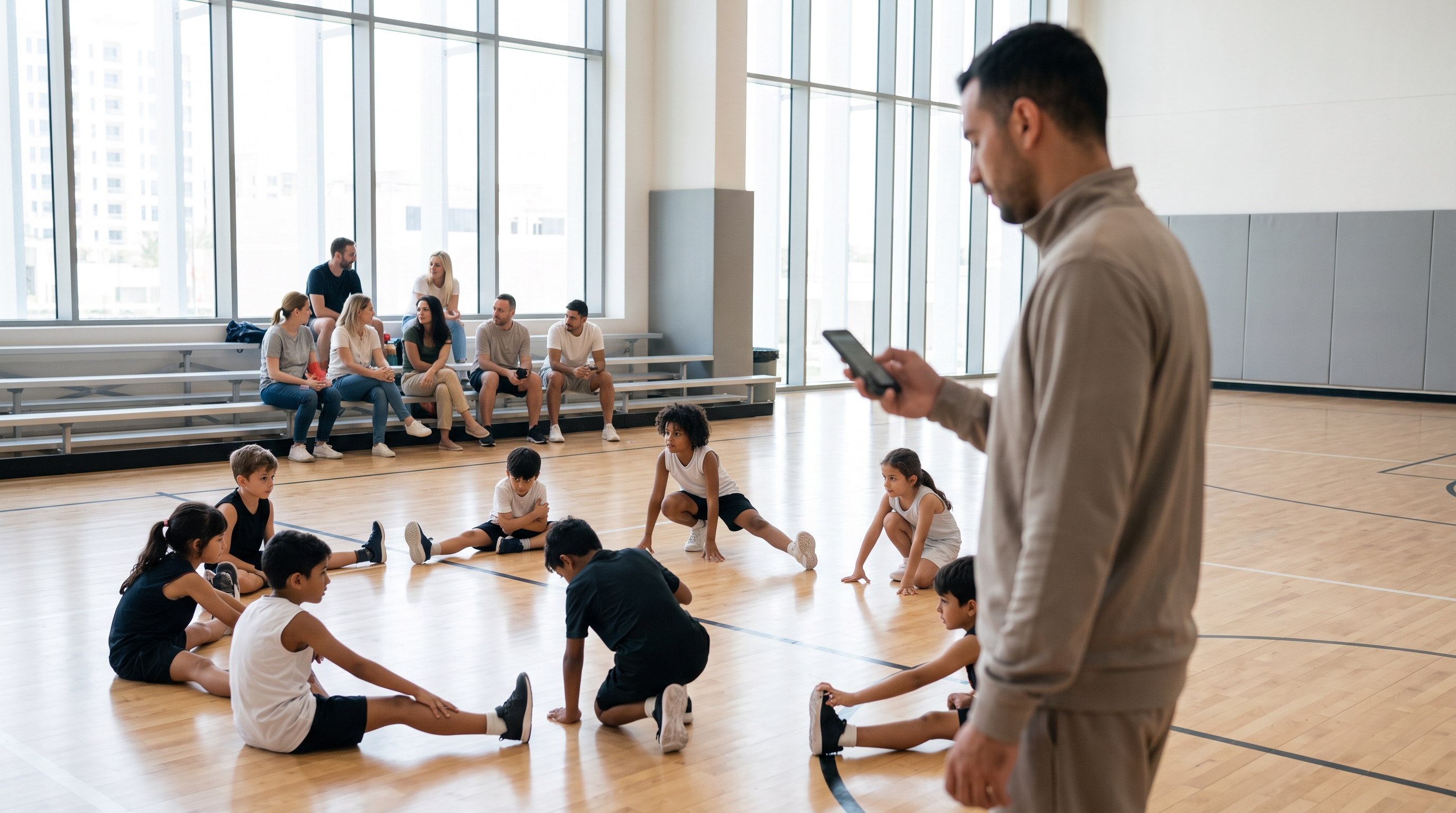
Start with eight minutes of active movement and ball-free games rather than long static stretches. Children should raise their body temperature, practise stopping safely and begin looking around before they receive a ball.
- Two minutes: Jog around the court, changing direction on the coach’s signal.
- Two minutes: Add movement commands such as defensive slides, high knees, heel kicks and controlled backpedalling.
- Two minutes: Play traffic lights: green means jog, yellow means walk, red means stop in a balanced basketball stance.
- Two minutes: Add reaction calls. Players touch a cone, return to space and freeze when the coach raises a hand.
Coach the landing and stopping position: feet apart, knees bent, chest up and eyes forward. Avoid turning the warm-up into a race, because beginners may focus on speed and lose control.
A useful instruction is: Stop under control, look up and find an open space. This prepares players for the next activities and introduces safe movement without lengthy explanations.
How can 15 kids practise ball handling and layups?
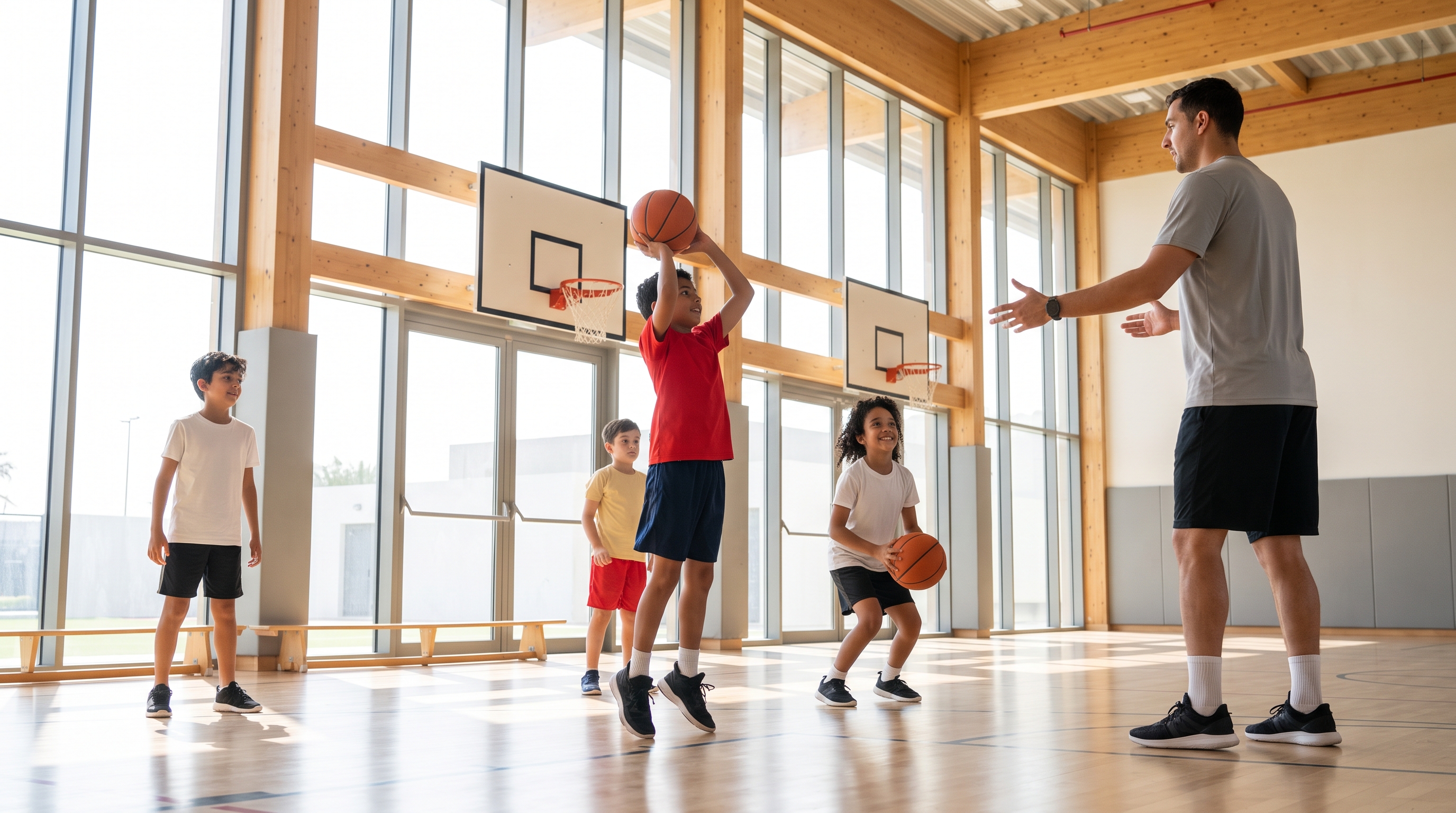
Give every child a ball for ball handling, then split the group into three groups of five for layups. This arrangement keeps the lines short and makes two hoops useful without leaving the third group inactive.
Ball handling: 8 to 23 minutes
For the first five minutes, let players practise in their own space. Call out each action for 20 to 30 seconds:
- Low dribbles with the right hand and then the left hand.
- Waist-high dribbles while walking forward and backward.
- Protecting the ball with the body while changing hands.
- Dribbling to a cone, stopping on two feet and turning away from pressure.
- Changing direction when the coach points left or right.
For the final 10 minutes, create a dribble route with cones. Players move one at a time through the route while the other four in their group practise stationary ball control. Ask them to keep the ball close, use their fingertips and look up every few dribbles.
Do not correct every mistake. Choose one coaching point, such as fingers on the ball, not the palm, then watch for improvement before adding another.
Layups: 23 to 38 minutes
Use one group at each hoop and the third group at a footwork station. Rotate every five minutes. At each hoop, place a cone near the top of the key and have players dribble in, take the correct two steps and finish softly off the backboard.
- Right side: step right-left, jump from the left foot and finish with the right hand.
- Left side: step left-right, jump from the right foot and finish with the left hand.
- Begin with no defender and no race to the basket.
- After two or three successful attempts, add a passive defender holding a bib or standing to the side.
At the footwork station, players can practise stepping over a line, jumping from one foot and landing under control, then receive a short pass from a partner. The aim is correct movement, not shooting power.
Give the same three reminders throughout: eyes on the square, use the backboard and land balanced. If players are struggling, allow them to start closer to the hoop without a dribble.
How should beginners learn passing in basketball?
Teach passing in pairs first, then add movement and a defender. Use 12 minutes for passing so children learn that a pass is followed by movement, rather than standing still and watching the ball.
- Three minutes: Pairs practise chest passes from a short distance. Hands finish pointing toward the partner, and the receiver shows a target.
- Three minutes: Pairs use bounce passes, aiming for the floor about two-thirds of the way to the receiver.
- Three minutes: Players pass, follow their pass and move to a new cone. The receiver catches with two hands before passing again.
- Three minutes: Groups of three keep the ball away from one passive defender. The defender increases pressure only when the group is ready.
With 15 players, make five groups of three. Give each group a triangle of cones. The passer should step toward the target, the receiver should call a name, and the third player should create a clear passing angle.
Use the coaching phrase pass, move, show your hands. Praise a good decision even when the pass is not perfect, especially when a child avoids forcing the ball through a crowded space.
How do you run small-sided basketball games with two hoops?
Run 3v3 games with short rotations so all 15 players stay involved. Make five teams of three, use one game at each hoop, and give the fifth team a three-minute ball-handling or passing challenge while it waits; rotate the teams every three minutes.
Set up two half-court games. Each game starts with a check at the top of the key, and the attacking team must make at least one pass before shooting. After a basket or defensive rebound, the ball is checked out beyond the marked line before play continues.
For a 22-minute game block, play seven rounds of three minutes (21 minutes) and use the remaining minute for quick rotations and reminders between rounds. Change the focus every two rounds:
- Rounds one and two: Find space after passing.
- Rounds three and four: Try a layup before taking a long shot.
- Rounds five and six: Defend without pushing or reaching across the body.
- Round seven: Let players make their own decisions while the coach observes.
Keep the rules simple. Stop play only for unsafe contact, travelling, double dribbling or a player who does not understand the restart. Ask questions during breaks: Where could you move after passing? or What did the defender leave open?
Finish with three minutes of walking, gentle breathing and a review. Ask each child to name one skill they improved. Record the group’s main focus for the next practice, such as left-hand dribbling or moving into open space.
Next step: Copy the timetable into your coaching notes, label the three groups before practice and place the cones before the first player arrives.
See how this works for your own club with a free MyClubAcademy trial.
Frequently asked questions
What equipment does a beginner basketball session need?
Prepare at least 10 basketballs, two hoops, cones, bibs or coloured shirts, and a whistle. If you have fewer than 10 balls, pair players carefully so one child practises while the other gives a simple coaching reminder or completes a footwork task.
How often should children aged 8 to 12 practise basketball?
One or two organised practices each week is a practical starting point, depending on the club timetable and the children’s other activities. Keep informal home practice short, such as 10 minutes of dribbling and passing against a wall.
How can a coach manage mixed ability in one basketball group?
Keep the same activity but change the challenge. A newer player may dribble with the stronger hand, while a more experienced player uses the weaker hand, changes direction or adds a passive defender.
Should beginners use full-court basketball rules?
Use only the rules that help the session objective. For beginners, focus first on travelling, double dribbling, safe contact, spacing and taking turns rather than stopping the game for every minor error.
MyClubAcademy
Put this into practice at your club
MyClubAcademy brings players, coaches, training sessions, QR attendance, subscriptions and chat into one admin panel, with iOS and Android apps for coaches and families.