Key takeaways
- Two to four players is usually the most useful range for a padel group lesson.
- One-to-one coaching gives the most coach attention, while four-player lessons create realistic doubles situations.
- Group players by level first, then adjust the number when age, confidence or objectives are very different.
- Use clear session packages so parents and players know whether they are booking private, semi-private or group coaching.
In this article
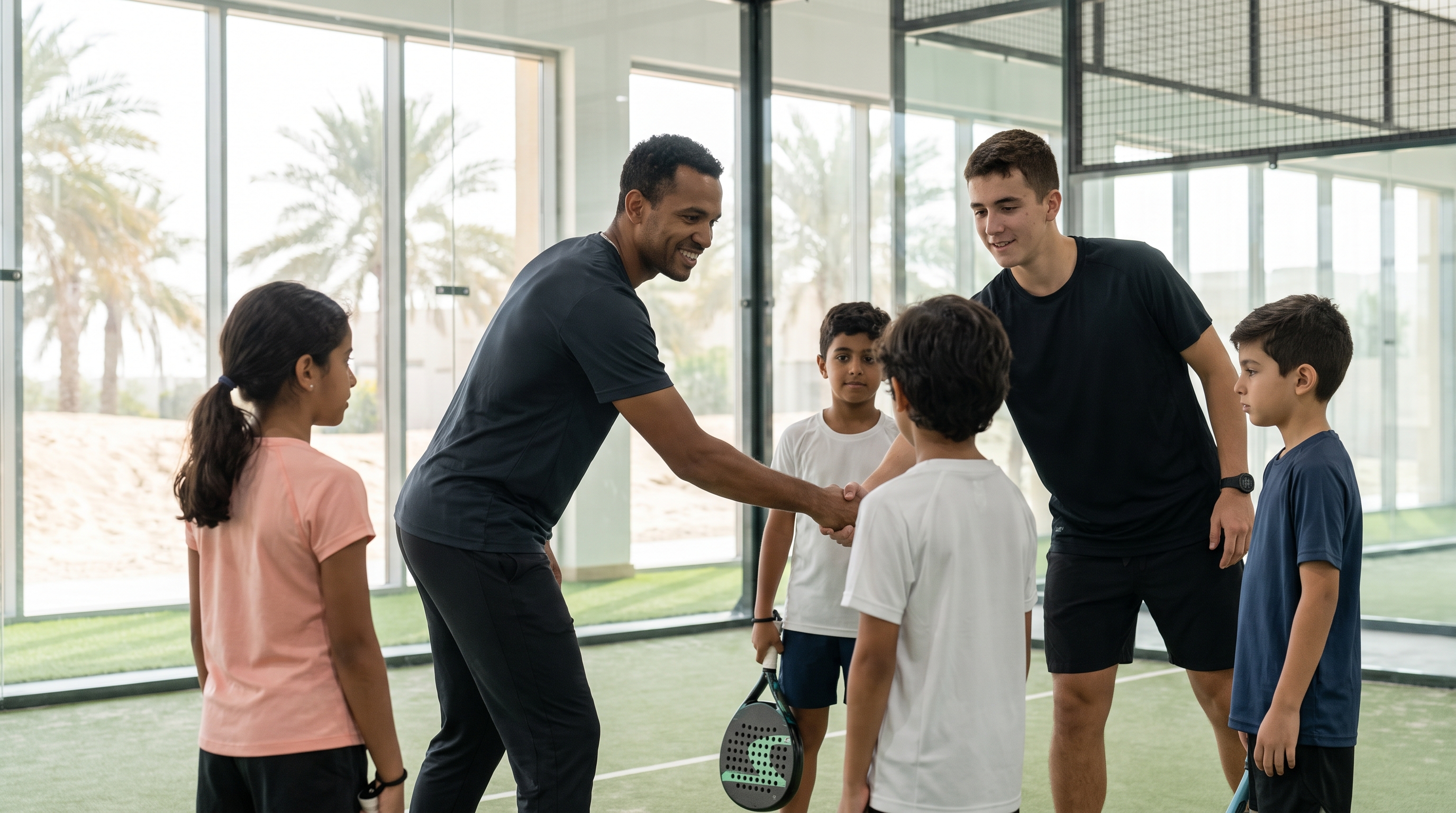
For most padel group lessons, the best size is two to four players. Choose one-to-one coaching for a specific technical goal, two or three players for more individual feedback, and four players when you want realistic doubles practice. Groups above four need extra court space, a second coach or a clear rotation plan.
The right number also depends on player level, age, lesson length and the purpose of the package. A beginner group needs more explanation and safety supervision, while an advanced group may benefit from four players practising positioning and match decisions.
How many players suit padel group lessons?
Two to four players suit most padel group lessons. This range gives players enough activity without making the coach divide attention among too many people.
| Group size | Best for | Main advantage | Watch out for |
|---|---|---|---|
| 1 player | Specific goals, detailed assessment or intensive technique work | Maximum coach attention | Less realistic doubles practice and a higher cost per player |
| 2 players | Friends, siblings or two players with similar ability | Many repetitions and frequent feedback | Less opportunity for four-player match situations |
| 3 players | Small groups with mixed drills and rotations | Good balance between attention and variety | One player may wait during some doubles exercises |
| 4 players | Players preparing for doubles games | Realistic court positioning and tactical play | Less individual feedback if the session is poorly organised |
As a simple academy rule, start a beginner or junior group with two or three players. Move to four when the players can follow instructions, control the ball safely and keep a rally going. If the group includes players with very different abilities, reduce the size or split it into two levels.
Is one-to-one coaching better than a group padel lesson?
One-to-one coaching is better for focused improvement, but group coaching is better for social learning and realistic play. The choice should match the player's goal rather than being treated as a permanent ranking of lesson quality.
- Choose one-to-one when a player needs help with one specific shot, wants a detailed technical assessment, has been away from the sport for a long time or needs a flexible time.
- Choose two players when friends want individual feedback but also want to practise against another person.
- Choose three players when the coach wants to combine technical exercises, feeding and controlled points with short rotations.
- Choose four players when the main target is doubles positioning, communication, serve returns and decision-making under pressure.
If a player is returning after an injury or medical condition, the coach should not decide readiness alone. The player should follow advice from an appropriate medical professional and any relevant federation or local authority requirements before joining normal training.
For example, Coach Ahmed might use a 45-minute private lesson with Sara to work on her backhand volley. He might then run a 60-minute lesson for Omar, Lina and Faisal that includes 15 minutes of warm-up, 20 minutes of directed drills and 25 minutes of conditioned points.
Do not describe a four-player session as private coaching. Explain that the value is live doubles practice and shared coaching time. This makes the package easier for parents and players to understand.
How should I group padel players by level?
Group players by practical playing ability and lesson objective, not only by age or how long they have attended the academy. A player who has attended for six months may still need beginner activities, while a new player with racket-sport experience may progress quickly.
Use a short assessment before assigning a regular group. Check whether each player can:
- Control a basic forehand and backhand at a safe pace.
- Return a coach-fed ball without regularly hitting the fence or another court.
- Understand where to stand during a rally and when to rotate.
- Follow simple instructions and maintain safe spacing.
- Play a short point without the coach stopping every few seconds.
A practical level structure could be:
- Starter: grip, contact point, basic movement and safety.
- Developing: consistent rallies, serve and return, basic net play.
- Game-ready: positioning, communication, transitions and point construction.
Keep players within roughly the same working level. A small difference is manageable if the coach can give two versions of the drill. A large difference usually means the stronger player gets bored and the newer player receives too little success.
For a junior class, also consider confidence and maturity. Two 10-year-olds may need different support even if their strokes look similar. Follow your federation and relevant local authority guidance for safeguarding, supervision, heat and medical arrangements, particularly for outdoor sessions in the Gulf.
How much court time does each player get in a padel lesson?
Each player should be active for most of the lesson, with waiting time kept short and planned. Four players can all be involved in a doubles activity, but each player may receive less direct feeding and correction than in a private session.
Use the session length and drill design to protect playing time:
- 45 minutes, two players: alternate feeding, hitting and short competitive tasks every five to eight minutes.
- 60 minutes, three players: use two players on court while the third performs a defined feeding, target or recovery task, then rotate every three to five minutes.
- 60 minutes, four players: use doubles points, pair rotations and small technical stations rather than having one player stand in a queue.
- 90 minutes, four players: allow time for technical work, tactical play and a match block without rushing the coach's feedback.
Before the lesson, the coach should know the planned rotation. For example, in a three-player lesson, label players A, B and C. After five minutes of cross-court rallies, A can feed, B and C rally, then B feeds while C and A rally. This is clearer than asking players to wait until they feel ready to enter.
Track two different things: active court time and individual feedback time. Four players may be active together during a doubles game, but each person still needs a short correction from the coach during the lesson.
How should a padel academy sell group lesson packages?
Sell packages by group size, number of sessions and attendance rules. Do not place private coaching and four-player group coaching in one unclear package, because the player experience and coach workload are different.
| Package name | Sessions | Recommended group | Good for | Attendance note |
|---|---|---|---|---|
| Private Focus | 4 one-to-one sessions | 1 player | Technical correction or a personal development target | Book a fixed weekly slot |
| Semi-Private Pair | 8 recurring sessions | 2 players | Friends or siblings progressing together | Name both players at registration |
| Small Group Progress | 8 recurring sessions | 3 players | Players who want coaching and regular rallies | Use a level-matched group |
| Doubles Academy | 12 recurring sessions | 4 players | Match play, positioning and tactical development | Set a make-up policy before enrolment |
| Introductory Session | 1 session | 1 to 3 players | Assessment before joining a regular class | Place the player after coach feedback |
Keep a clear enrolment record for the player's group, coach, recurring session and attendance terms. MyClubAcademy supports age groups, coaches, one-off and recurring sessions on one calendar, along with subscription packages and reminders before a subscription ends. You can try MyClubAcademy for your academy if you want help organising these club activities.
Send a clear message when a package is confirmed: “Omar is enrolled in Doubles Academy, Tuesdays at 6:00 pm, from 7 October. The group has four players and is aimed at game-ready players. Please arrive 10 minutes early and follow the make-up policy in your booking details.”
Review group size after the first two sessions. If the coach is stopping play constantly for safety or explanation, reduce the group. If players are waiting too often, redesign the rotations or move one player to another level. If four similar players are enjoying competitive doubles and receiving useful feedback, keep the group at four.
Next step: List every current padel player by level and objective, then assign each person to a one-, two-, three- or four-player trial session before selling a recurring package.
Frequently asked questions
Should a padel academy offer trial lessons before selling a package?
Yes. A short assessment or trial helps the coach check a player's level, movement, confidence and objectives before placing them in a group. It also reduces the risk of putting a complete beginner into a group that is already practising advanced tactics.
How should a padel academy handle a player who misses a group lesson?
Set the policy before payment and apply it consistently. You might offer a limited number of make-up sessions when space is available, but you should not promise an automatic replacement if the group is full.
Should junior and adult padel lessons use the same group size?
Not always. A group of four adults may work well when everyone can rally safely, while younger players may need fewer players, shorter activities or more supervision. Check your federation and relevant local authority guidance for safeguarding and supervision requirements.
Is a longer padel lesson better than adding another player?
Usually, a longer lesson is better when the group already has three or four players and needs more repetitions. Adding a fifth player often reduces individual attention unless you have a second court, an assistant coach or a carefully planned rotation.
MyClubAcademy
Put this into practice at your club
MyClubAcademy brings players, coaches, training sessions, QR attendance, subscriptions and chat into one admin panel, with iOS and Android apps for coaches and families.