Key takeaways
- Use age bands as a starting point, but adjust for ability, confidence, physical readiness and local federation guidance.
- Create beginner and advanced pathways without labelling young players permanently.
- Use small trial moves and regular reviews to decide when a player should change groups.
- Plan hoop and court sharing around group size, drill type, safety and coaching attention.
In this article
Basketball academy groups should be organised by age first, then adjusted for playing level, confidence, physical readiness and training goals. Start with clear age bands, place beginners and experienced players on suitable pathways, and review each player regularly rather than treating the first placement as permanent.
A good structure helps a coach choose appropriate drills, keeps games competitive and makes court sharing easier. It also gives parents a simple explanation of why their child is in a particular group.
How should basketball academy groups be set by age?
Use two-year age bands where possible, then check whether the players are close enough in maturity and experience to train safely together. The exact cut-off dates may depend on your federation, competition rules or school calendar, so check with the relevant basketball authority before publishing an official structure.
A practical starting structure for a community academy could look like this:
| Group | Typical ages | Main focus | Suggested training size |
|---|---|---|---|
| Mini Hoops | 5–7 | Movement, balance, simple games and enjoyment | 8–12 players |
| U9 | 8–9 | Dribbling, passing, shooting form and basic rules | 8–14 players |
| U11 | 10–11 | Footwork, spacing, defence and small-sided games | 10–14 players |
| U13 | 12–13 | Decision-making, team concepts and stronger technique | 10–14 players |
| U15 | 14–15 | Positionless skills, tactics, fitness and competition preparation | 10–16 players |
| U17 | 16–17 | Advanced team play, performance habits and game preparation | 10–16 players |
- Keep the youngest players in groups where the basket height, ball size and court rules match their development plan.
- Do not place a player in an older group only because they are tall. Look at coordination, decision-making, confidence and ability to cope with the session pace.
- If an age band has only three or four players, combine it with the closest age group and use level-based stations during practice.
How should basketball academy groups be divided by level?
Divide players into at least two pathways when numbers allow: a foundation or beginner group, and a development or advanced group. The names should describe the training pathway rather than make children feel that one group is permanently better than another.
Use a short assessment before placing new players. A 20-minute assessment can include five minutes of movement and warm-up, five minutes of dribbling and passing, five minutes of shooting close to the basket, and five minutes of a simple game or decision-making activity.
Score each area with a simple three-point scale:
- 1: needs frequent help or is new to the skill;
- 2: can perform the skill with some reminders;
- 3: performs the skill consistently and can use it during a game.
Also record two observations that numbers may miss: how the player responds to coaching and whether they can participate confidently with the group. For example, Sara may score mostly twos but understand instructions quickly and show strong effort. She could start in a development group with additional support rather than being placed in a beginner group solely because her shooting is not yet consistent.
Keep the level decision specific. Instead of telling a parent, “Your child is not advanced enough,” say, “Omar is starting in the foundation U11 group because he is still building his left-hand dribble and defensive footwork. We will review those areas after four weeks.”
How do you move players between basketball academy groups?
Use a review period of four to six weeks, then move players when the current group is no longer the right challenge. A player should not move because of one excellent session or one difficult game.
Before recommending a move, check four questions:
- Can the player complete the key skills of the receiving group at a useful level?
- Can they follow the instructions and session pace without constant one-to-one help?
- Will the move give them a better challenge without reducing confidence?
- Is there a suitable place in the receiving group, including coach attention and court space?
Use a two-session trial whenever possible. The current coach can tell the player, “You will train with the U13 development group on Tuesday and Thursday this week. We are checking whether the pace and challenge suit you.” After the trial, the two coaches should compare notes and speak with the parent.
Moves can work in both directions. A player who is struggling with the pace of an advanced group may benefit from returning temporarily to the foundation group to rebuild confidence. Present this as a training adjustment, not a punishment. Record the next review date so the player has a clear route forward.
Keep one short record for each review: current group, strengths, two development targets, coach recommendation and review date. An academy app such as MyClubAcademy can help staff keep age groups, coaches and recurring sessions organised in one calendar.
How can basketball academy groups share hoops and court space?
Share a court by dividing the session into zones and giving each group a clear task. Do not put two groups on the same hoop for full-speed shooting or contact drills unless the coaches have controlled the movement and spacing.
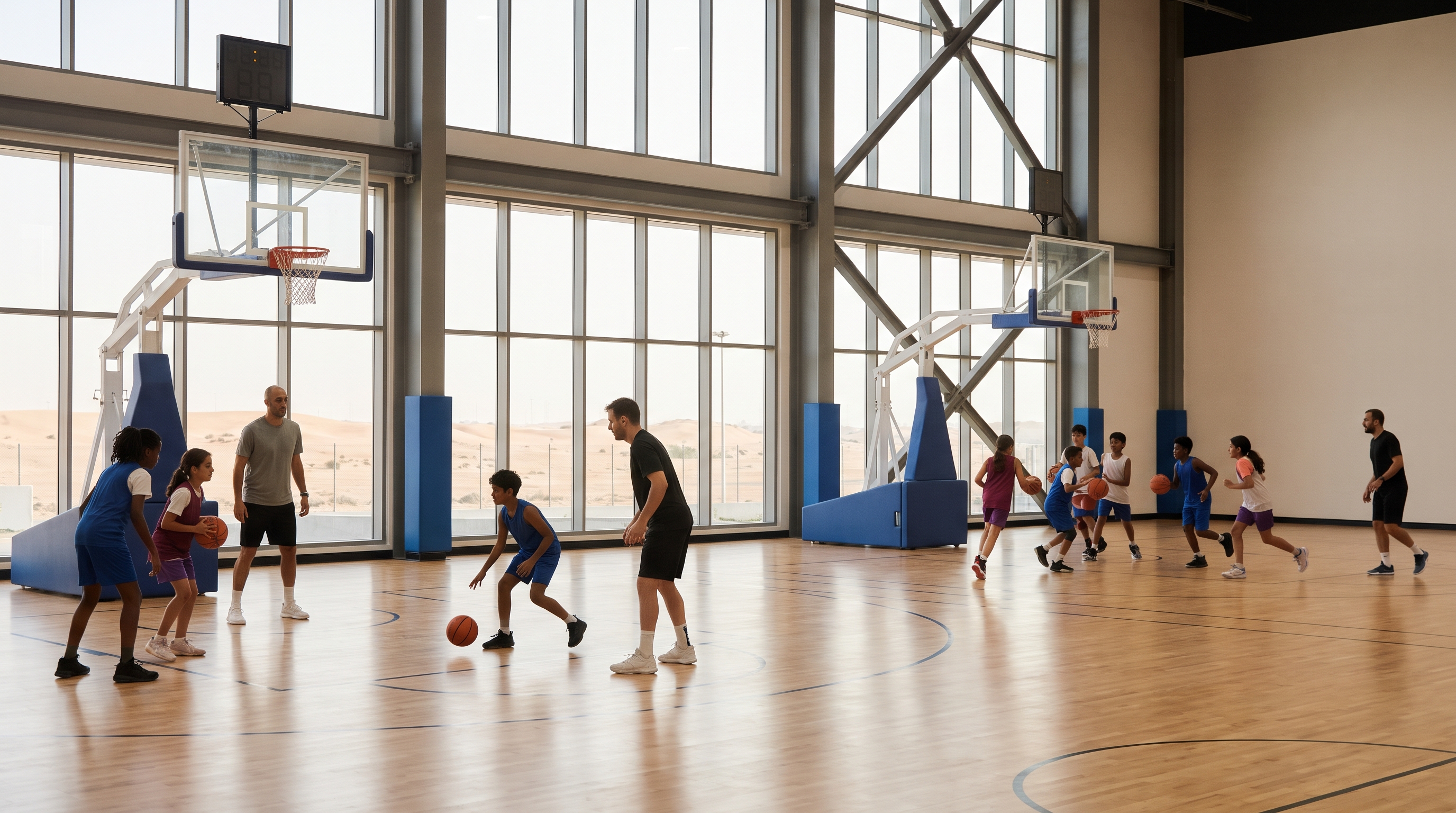
For example, an academy has 24 players, two coaches and one full court with six hoops:
| Time | Zone A | Zone B | Zone C |
|---|---|---|---|
| 0–10 minutes | U11 foundation: movement and ball handling | U11 development: passing under pressure | Both groups: dynamic warm-up lane |
| 10–25 minutes | Dribbling stations on two hoops | Shooting technique on two hoops | Coach-led footwork station |
| 25–45 minutes | Three-on-three games | Three-on-three games | Waiting players complete a passing challenge |
| 45–60 minutes | Lay-up circuit | Defensive movement circuit | Free-throw and cool-down area |
- Place younger or beginner players in the zone with the least crossing traffic.
- Use one-way movement around a shooting station so players do not run behind active shooters.
- Give each group a different colour of bib and a named meeting point.
- Keep one coach responsible for each group during competitive games.
- Reduce the number of balls in a crowded station rather than allowing uncontrolled movement.
If two groups need the same hoop, alternate five-minute blocks. A coach can use one group for close-range shooting while the other works on passing away from the basket, then switch on a clear signal.
What should a basketball academy group structure look like?
Build the structure around your actual player numbers, coaches, equipment and available hours. Do not create eight named groups if you only have enough players and staff to coach four properly.
Here is an example for an academy with 48 players, three coaches and three weekly court bookings:
| Group | Players | Level | Sessions | Hoop and court plan |
|---|---|---|---|---|
| U9 Foundation | 10 | Beginner | Saturday, 9:00–10:00 | Half court, three stations |
| U9 Development | 8 | Confident beginner | Saturday, 9:00–10:00 | Half court, two skill stations and games |
| U12 Foundation | 12 | Beginner to developing | Tuesday, 17:00–18:15 | Full court split into three zones |
| U12 Development | 10 | Intermediate | Tuesday, 17:00–18:15 | Full court, two coaches and small-sided play |
| U15 Performance | 8 | Advanced | Thursday, 18:00–19:30 | Full court, game situations and shooting blocks |
Review the structure every six to eight weeks. Look at attendance, coach workload, player progress, group size and whether players are receiving enough meaningful touches of the ball. If the U12 foundation group reaches 18 players, split it or add another coach before quality and safety suffer.
Share the structure with coaches in a one-page document. Include each group’s age range, level description, player list, coach, court zone, equipment and review date. Parents need the group timetable and expectations; coaches need the full operational version.
Next step: List your current players by age, experience and confidence, then create a four-week trial structure with one review date for every group.
Frequently asked questions
Should siblings train in the same basketball academy group?
Not automatically. Keep siblings together if they are close in age, ability and confidence, but separate them when one player needs a different pace or level of challenge. Explain that the decision is about development, not preference.
What should a player wear for a basketball academy assessment?
Ask the player to wear suitable sports clothing and basketball shoes, and bring water. The assessment should also consider any information the parent shares about previous experience, confidence, physical limitations or school commitments.
How many coaches should assess a player moving to a stronger group?
One coach can make the decision in a small academy, but two coaches provide a more balanced view when possible. Ask the current coach and receiving coach to compare the same criteria, such as ball control, decision-making, effort and ability to follow instructions.
What should parents be told before a new basketball group starts?
Share the group name, age range, level, training days, location, start time and what the player should bring. Also explain that groups may change after a review period so parents understand that placement is not permanent.
MyClubAcademy
Put this into practice at your club
MyClubAcademy brings players, coaches, training sessions, QR attendance, subscriptions and chat into one admin panel, with iOS and Android apps for coaches and families.